fda.vi
Functional Data Analysis using Variational Inference
Implements a variational Expectation-Maximization (VEM) algorithm
for smoothing one or multiple functional observations via basis function
selection. The algorithm estimates all model parameters simultaneously and
automatically, while accounting for within-curve correlation. The approach
provides a flexible and computationally efficient framework for smoothing
correlated functional data. The algorithm is described in da Cruz, A. C.,
de Souza, C. P., and Sousa, P. H. (2024). 'Fast Bayesian basis selection for
functional data representation with correlated errors.'
fda.vi
fda.vi is an R package that implements a variational expectation-maximization (VEM) algorithm for smoothing one or multiple functional observations via basis function selection. The algorithm estimates all model parameters simultaneously and automatically, while accounting for within-curve correlation. It provides a fast, scalable alternative to Bayesian sampling-based MCMC methods for smoothing functional curves with within-curve correlated errors via an Ornstein-Uhlenbeck covariance function.
The details of the variational EM algorithm can be found in da Cruz, de Souza and Sousa (2024).
Installation
# install.packages("pak")
pak::pak("desouzalab/fda.vi")
Quick Start
library(fda.vi)

data(toy_curves)

fit <- vem_fit(
  y      = toy_curves$y,
  Xt     = toy_curves$Xt,
  K      = 8,
  center = FALSE,
  scale  = FALSE
)
summary(fit)
#> ------------------------------------------------
#>  VEM Smooth Fit Summary
#> ------------------------------------------------
#> Basis Type            cubic_bspline
#> Curves (m):           3
#> Basis Functions (K):  8
#> Active Bases (per curve): 6, 6, 6
#>
#> Model Parameters (Representative):
#>   Point estimate for decay parameter (w): 6.217
#>
#>   Posterior q(sigma^2) ~ IG(delta1, delta2):
#>    delta1 (shape):  97
#>     delta2 (scale):  0.859869
#>
#>   Posterior q(tau^2) ~ IG(lambda1, lambda2):
#>     lambda1 (shape): 12.001
#>    lambda2 (scale): 1517.36
#> ------------------------------------------------
plot(fit, curve_idx = 1)
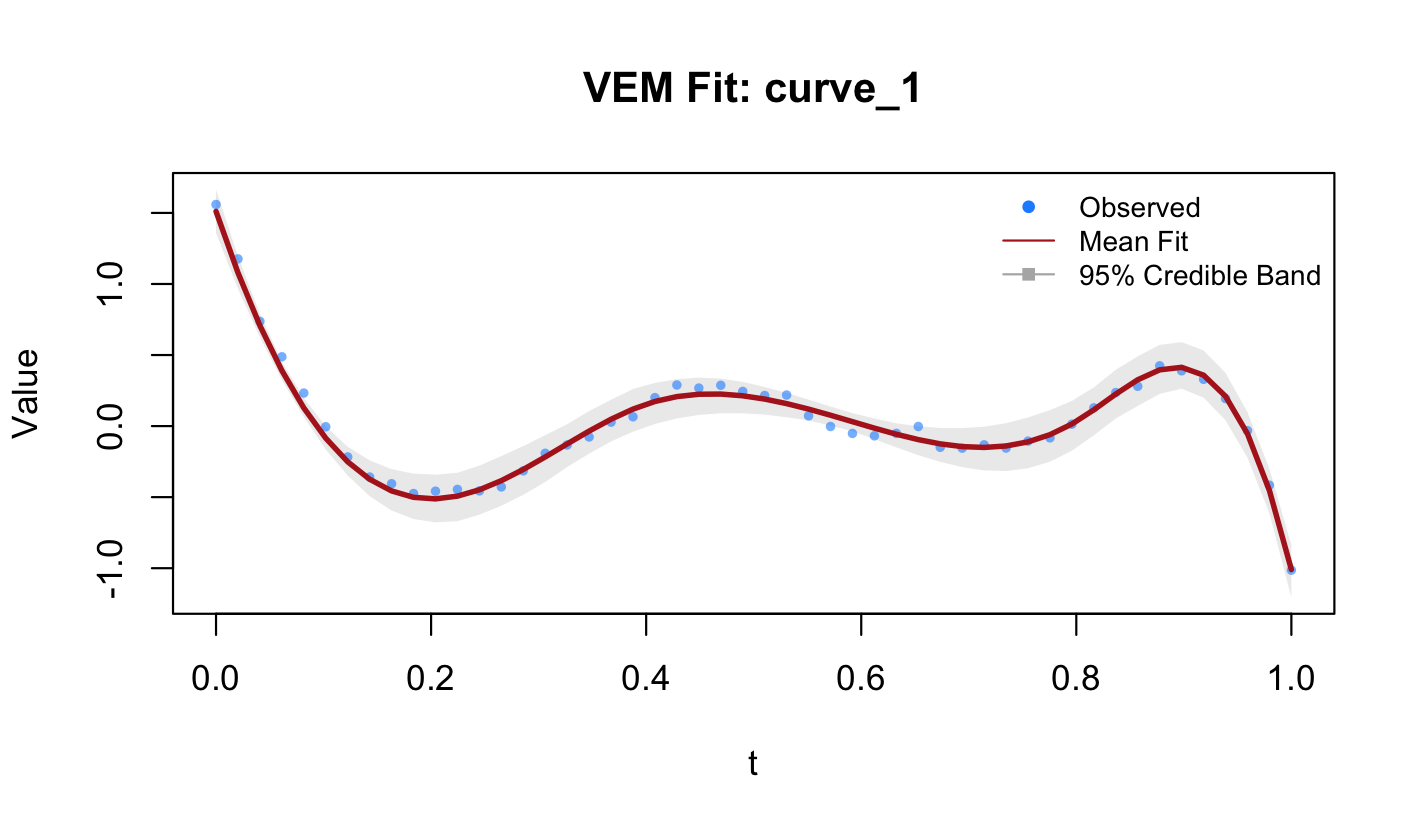
coef(fit)
#>      Curve_1    Curve_2    Curve_3
#> B1  1.5105434  1.6158541  1.5027916
#> B2  0.0000000  0.0000000  0.0000000
#> B3 -1.0173887 -1.1296271 -0.9889452
#> B4  0.4855913  0.7182764  0.8098905
#> B5  0.0000000  0.0000000  0.0000000
#> B6 -0.4088634 -0.7414497 -0.5324928
#> B7  1.0851575  1.1127756  1.2152763
#> B8 -1.0093923 -1.1186148 -0.9470451
Xt_new <- seq(0, 1, length.out = 200)
y_pred <- predict(fit, newdata = Xt_new)

head(y_pred[[1]])
#> [1] 1.5105434 1.3985729 1.2903498 1.1858269 1.0849569 0.9876925
Key Features
- Automatic Bayesian Basis Selection via sparsity-inducing priors on basis coefficients
- Uncertainty Quantification via 95% credible bands, constructed using the variational distributions of the basis coefficients and inclusion indicators
- Correlated (Within-Curve) Error Structure modelled explicitly using an Ornstein-Uhlenbeck covariance function, with the decay parameter estimated automatically in the M-step of the variational EM algorithm
- Automatic Selection of Number of Basis Functions K via generalized cross-validation (GCV) over a user-supplied grid of candidate basis sizes
- Multiple Basis Types supported: cubic B-splines and Fourier bases
- S3 User Methods:
plot(),predict(),coef(), andsummary()methods for fitted objects - Fast The variational EM algorithm converges in tens of iterations
References
da Cruz, A. C., de Souza, C. P. E., & Sousa, P. H. T. O. (2024). Fast Bayesian basis selection for functional data representation with correlated errors. arXiv:2405.20758. https://arxiv.org/abs/2405.20758
Citation
To cite the method implemented in this package, please use:
da Cruz, A. C., de Souza, C. P. E., & Sousa, P. H. T. O. (2024). Fast Bayesian basis selection for functional data representation with correlated errors. arXiv:2405.20758. https://arxiv.org/abs/2405.20758
@misc{dacruz2024vem,
  title     = {Fast {Bayesian} basis selection for functional data
               representation with correlated errors},
  author    = {da Cruz, Ana Carolina and de Souza, Camila P. E. and
               Sousa, Pedro H. T. O.},
  year      = {2024},
  note      = {arXiv:2405.20758},
  url       = {https://arxiv.org/abs/2405.20758}
}