greta.gp
Gaussian Process Modelling in 'greta'
Provides a syntax to create and combine Gaussian process kernels
in 'greta'. You can then use these kernels to define either full rank or
sparse Gaussian processes, and project a fitted process to new coordinates.
This lets you include Gaussian process components in the statistical models
you write with 'greta'. This is an extension to the 'greta' software, Golding
(2019)
greta.gp: Gaussian Process in greta


greta.gp extends greta to let you define Gaussian processes as part of
your model. It provides a syntax to create and combine GP kernels, and
use them to define either full rank or sparse Gaussian processes.
Installation
You can install the current release version of greta.gp from CRAN:
install.packages("greta.gp")
Or install the development version of greta.gp from
r-universe:
install.packages("greta.gp", repos = "https://greta-dev.r-universe.dev")
You can also install the development version of greta.gp via GitHub:
remotes::install_github("greta-dev/greta.gp")
Example usage
# simulate data
x <- runif(20, 0, 10)
y <- sin(x) + rnorm(20, 0, 0.5)
x_plot <- seq(-1, 11, length.out = 200)
library(greta)
library(greta.gp)

# hyperparameters
rbf_var <- lognormal(0, 1)
rbf_len <- lognormal(0, 1)
obs_sd <- lognormal(0, 1)

# kernel & GP
kernel <- rbf(rbf_len, rbf_var) + bias(1)
f <- gp(x, kernel)

# likelihood
distribution(y) <- normal(f, obs_sd)

# prediction
f_plot <- project(f, x_plot)
# fit the model by Hamiltonian Monte Carlo
m <- model(f_plot)
draws <- mcmc(m, n_samples = 250)
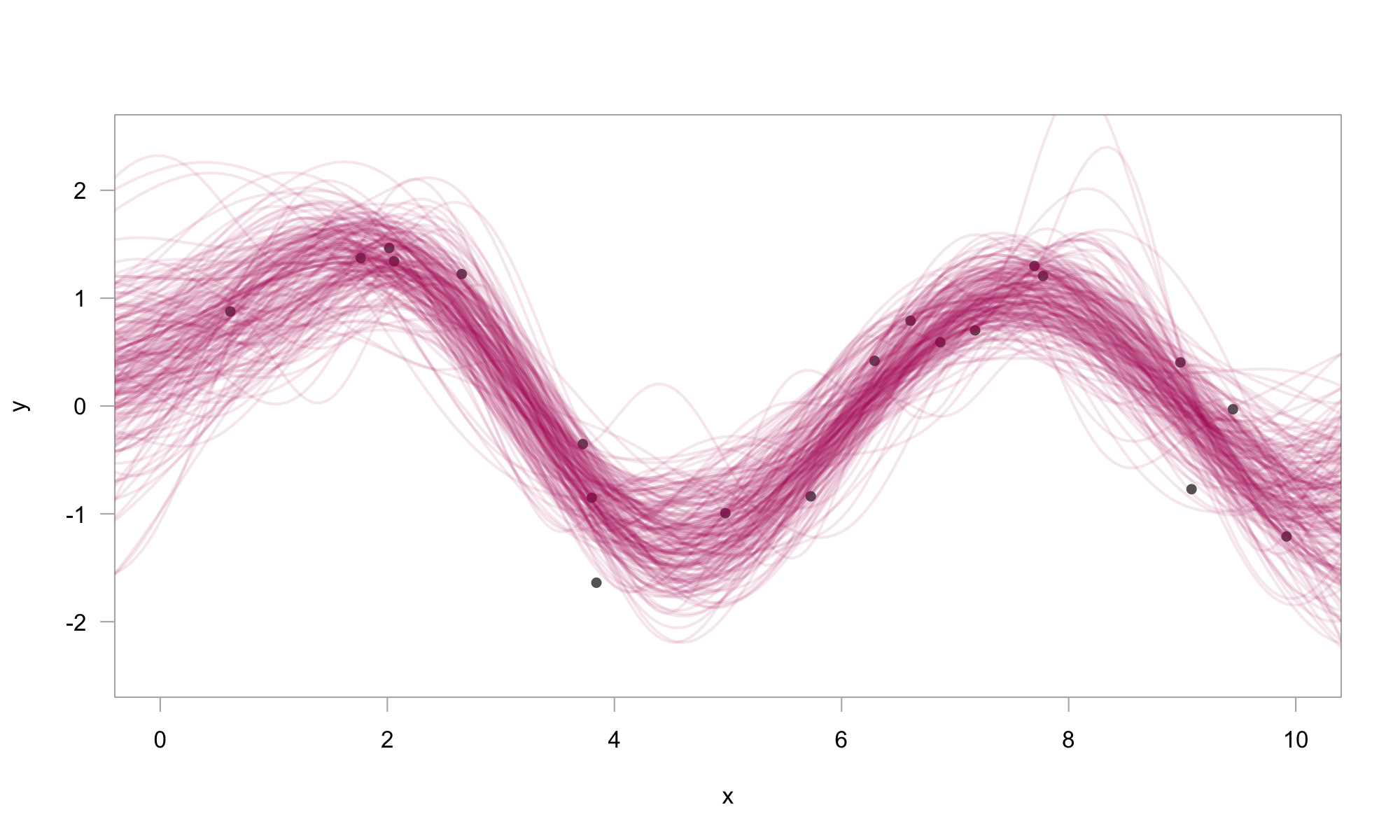
# plot 200 posterior samples
# plot 200 posterior samples
plot(
  y ~ x,
  pch = 16,
  col = grey(0.4),
  xlim = c(0, 10),
  ylim = c(-2.5, 2.5),
  las = 1,
  fg = grey(0.7),
)
for (i in 1:200) {
  lines(draws[[1]][i, ] ~ x_plot,
    lwd = 2,
    col = rgb(0.7, 0.1, 0.4, 0.1)
  )
}
Code of Conduct
Please note that the greta.gp project is released with a Contributor Code of Conduct. By contributing to this project, you agree to abide by its terms.