mascot
Live Mood-Driven Mascots for 'Shiny' Apps and 'Quarto' Sites
Adds a character drawn in code to 'Shiny' apps and 'Quarto' sites. The character shows a mood with status text beside it and animates when the mood changes; a 'Shiny' server can change its mood, status, speech bubble and gestures, and a click can run an action or open a menu. It follows light and dark mode and takes its colours from built-in palettes or custom colours. Custom characters can be described in 'JSON' and checked before use, and an interactive app demonstrates every function.
mascot 


Live, mood-driven mascots for Shiny apps and Quarto sites. A character drawn in code shows a mood and gives a short wiggle when the mood changes, with status text beside it so the face never carries meaning alone.
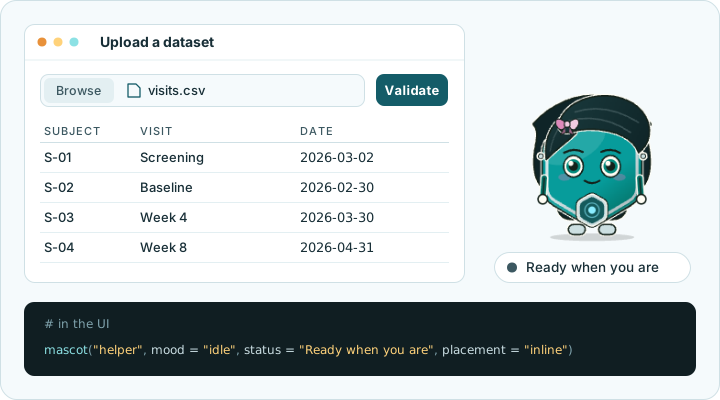
Set the mood from R when a form needs attention or a task finishes. Mascots follow light and dark mode, can use your
brand colours, work offline and respect reduced-motion settings. The package is built for GxP work: use it alongside
your app's field errors and results.
Status: some features are experimental.
Get started · Meet your mascots · Function reference
Installation
mascot needs R 4.1.0 or later. Install the released version from CRAN:
install.packages("mascot")
Or install the development version from GitHub:
# install.packages("pak")
pak::pak("insightsurge/mascot")
Try the studio
Explore the characters and functions in a local app, change the controls and copy the R code that matches what you
see. The studio is experimental and needs the optional packages bslib (0.7.0 or later) and knitr installed.
mascot::mascot_studio()
Run this in an interactive R session. The studio works offline and offers only the built-in characters. See the studio guide for each function.
In a Shiny app
Put this in app.R and run it. Click Say hello to change Tessa's mood from idle to happy and update the status
text. Tessa gives a short wiggle as her mood changes, unless the visitor has asked for reduced motion.
library(shiny)
library(mascot)

ui <- fluidPage(
  mascot(
    "helper",
    mood = "idle",
    status = "Ready to greet you",
    placement = "inline"
  ),
  actionButton("greet", "Say hello")
)

server <- function(input, output, session) {
  observeEvent(input$greet, {
    update_mascot("helper", mood = "happy", status = "Hello!")
  })
}

shinyApp(ui, server)
The four built-in characters are Tessa, Sela, Knurl and Neer. They share five moods: "idle", "thinking",
"happy", "worried" and "celebrating". Use mascot() in the UI and update_mascot() in the server to reflect
your app's state. The Get started article covers forms,
long tasks, themes and more examples.
In a Quarto page
Put this in an R chunk in a Quarto HTML page:
mascot::mascot("helper", mood = "happy", status = "Rendered with Quarto", placement = "inline")
Here the mascot is static. Its mood and status are set when the page is rendered, and it gets no live Shiny updates. See
Get started for details and caveats. A Quarto shortcode
is planned for 0.2.0.
Development status
Tessa and Sela are stable. The following are experimental and may change in a later release: Knurl and Neer,
mascot_studio(), mascot_preview(), mascot_theme(css =), drag = "free", the mapping of bslib::bs_theme()
colours to character parts, and the character file format.
You can read a local JSON character file with mascot_read_character() or check JSON text or a parsed list with
mascot_check_character(). Both functions are experimental; their arguments, results and diagnostics may change
in a later release. You can preview a checked character and use it in Shiny; the studio does not take custom
characters yet. Public functions for saving and registering characters and palettes are planned for a later
release. See Make your own character.
The coverage badge counts the R code the tests run. The JavaScript engine that draws and animates the mascots is tested in a browser and is not part of that figure.
The scope and planned releases and known users give the wider context.
Getting help and contributing
Start with the documentation. To report a bug or suggest a feature, open an issue using the matching form. Include a small example that shows the problem, built on synthetic data, and say which package version you have.
For contributions, read the contributor guide, including its conduct and data guidance. Everyone taking part is asked to follow the code of conduct. To report a security problem privately, see the security policy. The engineering standards explain the package's checks and conventions.
Licence
MIT. See the licence.